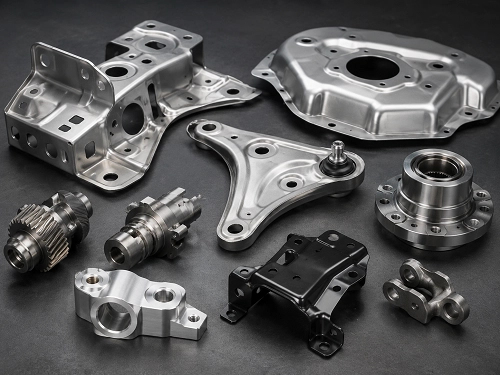
The modern automobile is assembled from thousands of precision-made components, and among the most critical are stamped metal parts and machined parts. These processes form the structural, functional, and aesthetic backbone of vehicles — from body panels and brackets to fasteners and interior trim hardware. As a manufacturer specializing in non-standard stamping parts, welding parts, and assembly parts, ACRO Metal Products Ltd. supports automotive OEMs and tier suppliers with custom solutions engineered from customer drawings, samples, and technical specifications. For a full overview of current offerings, see the ACRO Metal product catalog.
Metal stamping is a cold-forming process in which flat sheet metal is fed into a press and shaped using a die and punch to produce a specific geometry. In the automotive sector, stamping is used to create high-volume, dimensionally consistent parts such as brackets, panels, clips, and structural reinforcements. The process typically includes several stages:
| Process Stage | Function | Typical Automotive Application |
|---|---|---|
| Blanking | Cuts flat sheet into a base shape | Panel blanks, bracket outlines |
| Piercing | Creates holes for fasteners or clearance | Mounting brackets, trim hooks |
| Bending / Forming | Shapes flat blanks into 3D geometry | Door panels, seat frames |
| Progressive Die Stamping | Combines multiple operations in sequence | High-volume interior/exterior trim parts |
| Coating (E-coating / Powder) | Adds corrosion resistance and finish | Door panels, mudshields, suspension parts |
ACRO's tooling workshop independently designs and manufactures single-punch and progressive dies according to customer drawings, which allows tighter dimensional control and shorter lead times on non-standard parts. Examples of finished stamped components can be viewed on the Auto Stamping Parts page, including E-Coating Panels for Auto Doors and Powder-Coated Mudshields and Seats for luxury SUVs.
While stamping excels at forming sheet metal quickly and repeatably, CNC machining removes material from solid stock (billet, bar, or forged blank) to achieve tight tolerances that stamping alone cannot deliver. In automotive supply chains, machined parts are commonly specified for interfaces where fit, torque, or sealing performance is critical — such as shaft components, connector housings, and precision brackets that mate with stamped or welded assemblies.
| Comparison | Metal Stamping | CNC Machining |
|---|---|---|
| Typical Tolerance | ±0.05–0.1 mm | ±0.01–0.02 mm |
| Best-Fit Volume | Medium to very high volume | Low to medium volume, high precision |
| Material Utilization | High (forming, minimal waste) | Lower (subtractive process) |
| Common Automotive Parts | Panels, brackets, clips, trim hooks | Shafts, housings, precision fittings |
| Material | Key Properties | Typical Use |
|---|---|---|
| Cold-rolled steel | Good formability, cost-effective | Brackets, panels |
| High-strength steel (HSS/AHSS) | High strength-to-weight ratio | Structural reinforcements |
| Galvanized steel | Corrosion resistant coating | Exterior and underbody parts |
| Aluminum alloys | Lightweight, corrosion resistant | Weight-sensitive components |
| Stainless steel | Corrosion and heat resistance | Trim, exhaust-adjacent hardware |
Many automotive components require more than one process to reach a finished, installable state. A typical workflow moves from stamping to welding, surface treatment, and final assembly:
Automotive suppliers are held to strict quality management requirements. ACRO Metal Products Ltd. holds ISO 9001 and IATF 16949 certifications, supported by a documented quality control system intended to ensure dimensional stability and process repeatability across production runs. Details of the company's facilities and inspection processes are available on the Company Profile and Product Equipment pages.
Stamped and machined metal parts are found throughout a vehicle's structure and systems. Common application areas include door and interior trim brackets, seat frame hardware, mudshields, and underbody reinforcements, several of which are documented on ACRO's Auto Industry application page and the related Truck application page.
Automotive programs frequently require non-standard geometries that off-the-shelf tooling cannot produce. Having an in-house tooling workshop capable of designing single-punch and progressive dies allows a supplier to iterate on prototypes quickly, control lead times, and maintain tighter cost control across the product lifecycle — a capability relevant to buyers evaluating long-term supplier relationships rather than one-off orders.
Material specifications, coating requirements, and automotive quality standards continue to evolve alongside vehicle electrification and lightweighting trends. Readers interested in ongoing developments in stamped and machined component manufacturing can follow updates on the Industry News section and Company News section of the ACRO Metal website, alongside the full product catalog.
Stamped metal and machined parts remain foundational to automotive manufacturing, balancing high-volume forming with precision machining to meet the diverse tolerance and performance needs of modern vehicles. For custom stamping, welding, and assembly solutions built around specific drawings and technical requirements, further information and direct inquiries are available through ACRO Metal's Contact page.